
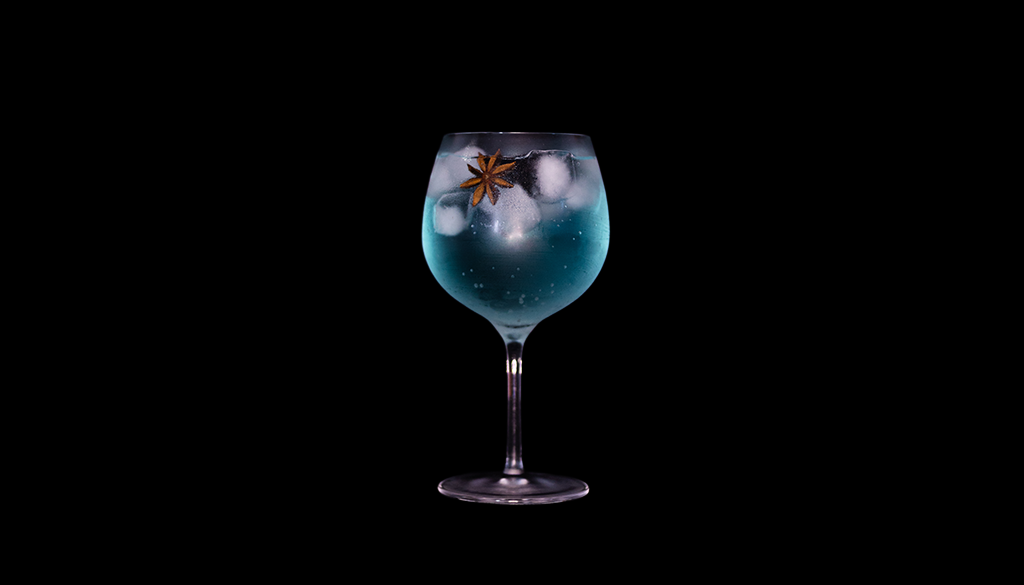
The Goeie Mie Gin & Tonic
A Leiden Love Letter (and a killer recipe)
There are gins that strut, and there are gins that tell a story. Goeie Mie Gin does both. It arrives in a bottle shaped like an apothecary relic, pours bright and floral, and carries a narrative heavy enough to make not only its home, Leiden, but also the rest of the world sit up and take notice. The story is so remarkable it even made its way into the Guinness Book of Records, because the woman behind the name was one of the most prolific poisoners in history.
For the author of this blog, this isn’t just a gin from Leiden (or Leyden); it is a gin made in the city where she was born and raised. I love gin, my city and a good story. Goeie Mie Gin gives all in one glass. 😉
🔎 A Deep Dive Into Goeie Mie (Gin)
The Real Story of Goeie Mie — Maria Catharina Swanenburg
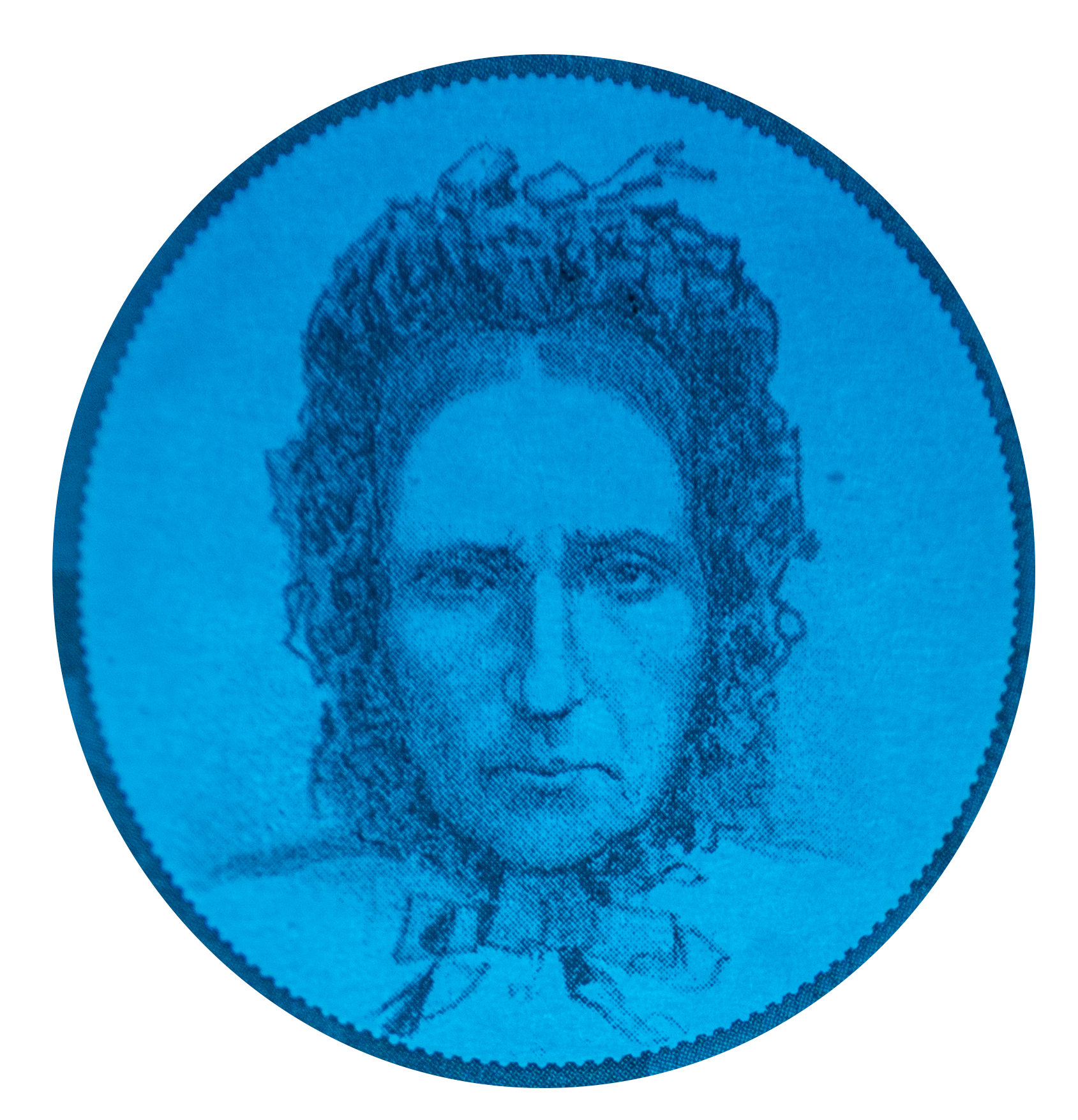
“Goeie Mie” (Good Mie) wasn’t always a nickname you expected to hear attached to a headline. Maria Catharina Swanenburg was born in Leiden in 1839. To the community around her, she was the kindly neighbour who helped the sick and looked after children. That reputation, that trust, is exactly what made her crimes possible.
Over a short period in the early 1880s she poisoned dozens of people in her care. Modern research and court files list 27 confirmed deaths. Historians, however, argue the number was far higher: over 90 people were suspected to have been poisoned, around 50 of those died, and 27 were confirmed in court. At least 60 more were left chronically ill. The case was so shocking it even landed Maria in the Guinness Book of Records as one of history’s most prolific female poisoners.
⚗️ How Did She Do It?
Maria used arsenic — or “white arsenic,” as it was known in the 19th century. She often stirred it into porridge or milk. Witnesses later reported that milk given by Maria sometimes tasted odd, a faint bitterness that survivors remembered.
At that time, arsenic was alarmingly easy to buy. It was sold openly in paint shops as an ingredient for pigments and pest control. The poison came in large buckets of powder, with instructions that it should always be carefully mixed with other substances before use. Maria, however, skipped this step. She would simply scoop the arsenic, which stayed on top without mixing, straight from the bucket and add it into food or drink. This ensured the arsenic remained in its most concentrated and deadly form. What was meant to be diluted for rats or mixed for household use instead went directly into her victims’ kitchens.
Arsenic poisoning was insidious. A large dose killed quickly, but Maria often used repeated small doses. Victims would suffer stomach cramps, vomiting, and wasting illnesses that could easily be mistaken for other diseases of the time. Chronic exposure slowly damaged organs until death followed weeks later.
❓ But… Why?
At first, Maria poisoned for money. She targeted people whose wills she had influence over, collecting insurance payouts and inheritances. Over time, however, the motive blurred. Even children she babysat became victims, suggesting that what began as financial gain had turned into something far darker — a compulsion without reason.
The Arrest that Shocked Leiden
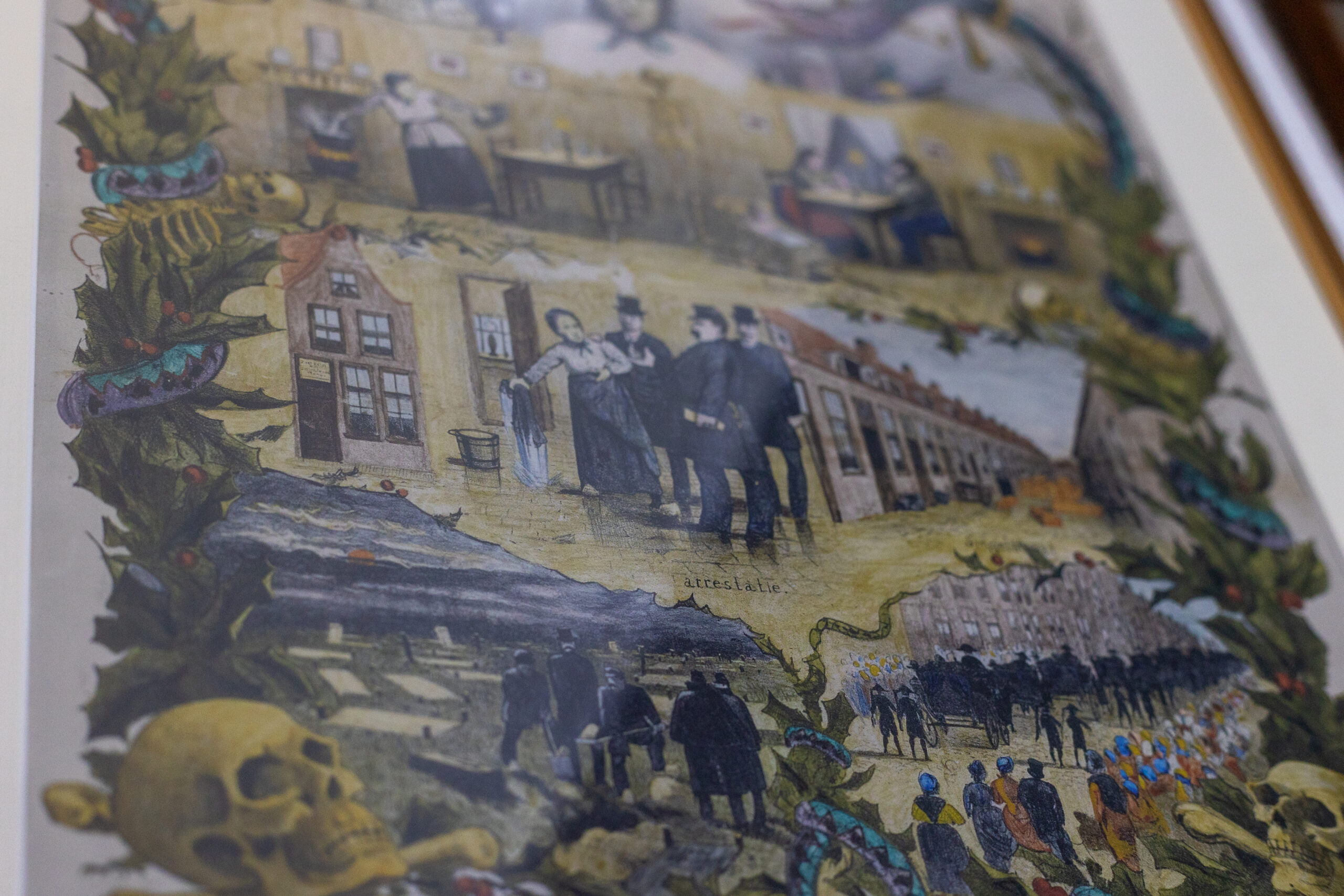
The end of Maria’s reign of terror came in December 1883, when suspicions in Leiden finally grew too strong to ignore. Doctors noticed a disturbing pattern: families connected to Maria kept falling mysteriously ill, often after she brought them food or drink. When the Leiden widow Christina van der Linden and two of her daughters died suddenly, investigators ordered chemical tests. Their suspicions were confirmed when high levels of arsenic were found. Maria was arrested that same month and brought to trial in The Hague, where the court convicted her of at least 27 murders. She was sentenced to life imprisonment and spent the rest of her days in the women’s prison in Gorinchem, where she died in 1915. Her arrest ended one of the darkest chapters in Leiden’s history, but the memory of “Goeie Mie” lingered in whispers long after her cell door closed.
The Story of Goeie Mie Gin — Josine, the Maker of the Gin
Fast-forward to the 21st century. Enter Josine Heijnen, a Leiden native, historian, and storyteller. She was already known for her work on 1001 Vrouwen uit de Nederlandse geschiedenis (1001 Women from Dutch History), a project exploring overlooked women in Dutch history. While researching, she stumbled back into the story of Maria “Goeie Mie” Swanenburg — a woman whose name had all but disappeared from Leiden’s public memory.
Josine found the paradox irresistible: Maria had been both the friendly neighbour delivering soup and the terror who poisoned entire families. How could such a dramatic, chilling, and very Leiden story have been forgotten? She decided to bring it back in a way no one could ignore: through a gin.
🧪 Why the Name is Complicated (and brilliant)
Naming a gin after a poisoner is provocative, but Josine’s approach was more than shock value. She wanted to reclaim and retell the story, using gin as a medium. Just as Leiden’s history is steeped in science, medicine, and experimentation, this gin would tell a story through its botanicals.
At first, Josine considered using pepper as a key botanical. “Too much pepper and you die” was the concept. But in the stills, pepper didn’t work. Then came the breakthrough: elderberries. Raw, uncooked elderberries are toxic – only safe after processing. Suddenly, it clicked. Elderberries carried the perfect symbolism, echoing Maria’s poison while creating a gin that was actually beautiful to drink.
Josine collaborated with distillers and botanists in the Netherlands to craft a London Dry–style gin that was both authentic and modern. Elderflower for perfume, elderberry for depth, and carefully chosen spices for balance. Every choice was intentional. For Josine, the gin had to tell a story, just like her book. And it worked.
She even pitched the gin on Dutch Dragon’s Den, winning over investors and giving Goeie Mie Gin the momentum to step onto the national stage.
The Bottle — Apothecary meets Art 🏺
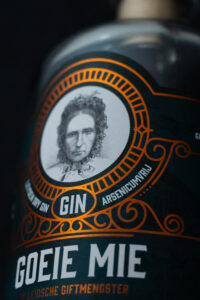
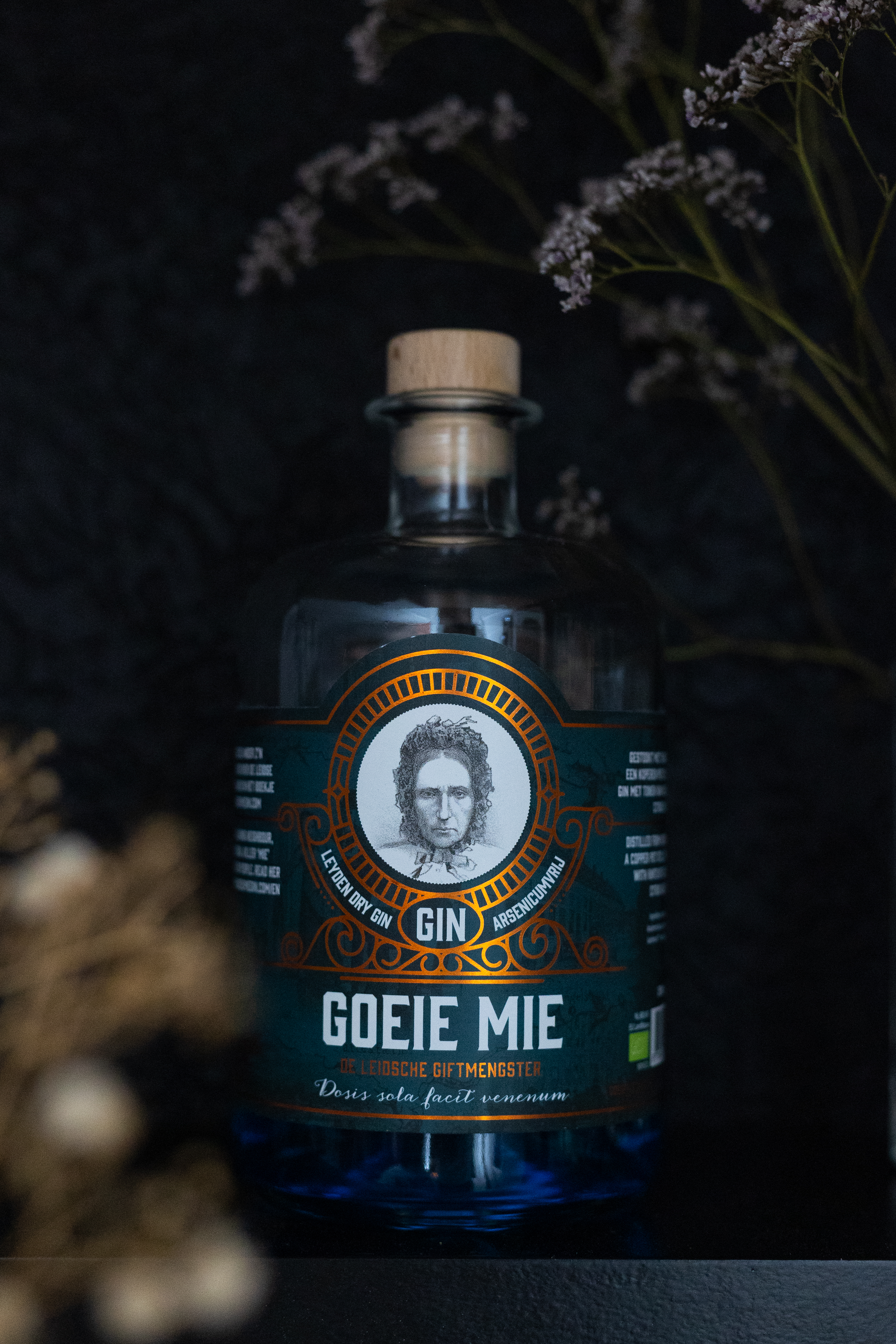
The bottle itself is as much a storyteller as the gin inside. Its pharmacy shape echoes the 19th-century world where spirits, tonics, and poisons often sat side by side on the same shelf.
Look closer and you’ll see clever details. The Latin motto, “Dosis sola facit venenum” — only the dose makes the poison — is a chilling nod to Maria’s arsenic. The label design hides coffin-like shapes and subtle skull motifs, a wink to those who dare to look closer. The label also jokes that the gin is ‘arsenicumvrij’ — arsenic-free — hinting to its dark inspiration.
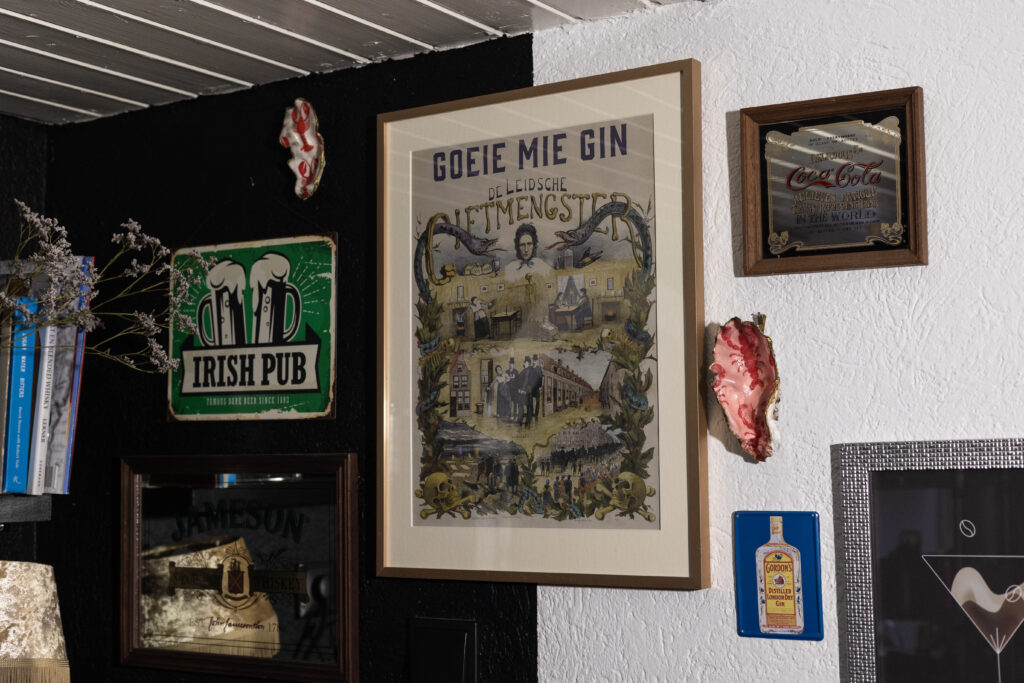
Scan the bottle with your phone, 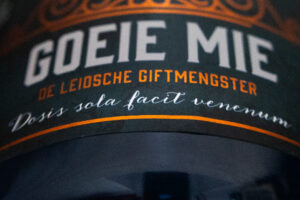 and the story of Goeie Mie comes alive in augmented reality. When buying the bottle, preferably in one of Leiden’s liquor stores, each bottle comes with a collector’s poster tying together Leiden, Maria, and the gin’s story. A poster that hangs beautifully in your home bar, with a bottle that looks like it belongs in a cabinet of curiosities. And that’s exactly the point.
🌿A Story in Flavour — Botanical Breakdown
To understand Goeie Mie’s flavour, you need to know Leiden’s scientific legacy. In the 17th century, Franciscus Sylvius, a physician at Leiden University, experimented with spirits flavoured with juniper to treat stomach ailments. His “genievre” (or jenever) became the ancestor of modern gin. What began as medicine evolved into pleasure. That medicinal-meets-botanical tradition flows directly into Goeie Mie.
The botanical cast:
- Juniper: the backbone. Piney, slightly citrusy, gentle rather than harsh.
- Elderberries & elderflower: the symbolic heart. Honeyed perfume and fruit depth.
- Citrus peel & lemon oil: brightens and lifts, added post-distillation.
- Cardamom, coriander, cinnamon: subtle warmth and spice without overwhelming.
Production Secrets 👀
Unlike most London Dry gins that redistill neutral grain spirit with vapour-infused botanicals, Goeie Mie starts with a natural fermentation of its botanicals. Elderberries, elderflower, and others contribute directly to the base alcohol. This mash is then copper-pot distilled, often multiple times, before finishing with lemon oil.
This process explains why Goeie Mie tastes rounder, softer, and more floral. The gin sometimes even shows a faint blue tint, caused by compounds from juniper bark that survive fermentation. It’s chemistry meeting art.
🍸 Step-by-Step Guide to the Perfect Poison: Goeie Mie Gin & Tonic
Any Gin & Tonic is all about balance—the right ratio, the right ice, the right tonic. Just like Bombay Sapphire shines with its ideal tonic, Goeie Mie Gin reaches its full potential when paired thoughtfully. The floral, elderflower-led botanicals need space to bloom, while the soft juniper backbone holds everything together.
The classic serve pairs Goeie Mie with Fever-Tree Indian Tonic, whose balanced quinine bitterness lifts the floral botanicals without overpowering them. Adventurous drinkers may also experiment with other tonics — a Mediterranean tonic enhances citrus oils, while elderflower tonic doubles down on honeyed perfume.
Garnishes matter just as much. A lemon twist brightens the finish; thyme or rosemary echo the gin’s spice backbone. Star anise adds licorice notes, and frozen blackberries melt slowly, tinting the drink purple and echoing elderberries.
1. Choose a balloon glass (Copa de Balon)
This isn’t just for aesthetics. A wide, rounded bowl allows Goeie Mie’s floral and spicy botanicals to bloom, letting the elderberry, elderflower, and juniper aromas shine while offering space for ice, tonic, and garnishes. Think of it as a little stage for a botanical performance.
2. Fill the glass to the top with large, clear ice cubes
Big ice melts slower, keeping your G&T cold without watering it down. Avoid cloudy ice—it dilutes faster and dulls the delicate flavours.
3. Measure 50 ml of Goeie Mie Gin
Precision matters. You want enough spirit to taste the floral depth and subtle spice, but not so much that it overpowers the tonic. Chilling the gin beforehand ensures the flavours stay crisp and vibrant.
4. Top with 150 ml of tonic water 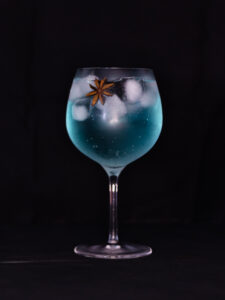
Fever-Tree Indian Tonic is perfect, with its balanced bitterness that lifts Goeie Mie’s botanicals. If you want to experiment, a Mediterranean tonic highlights the citrus oils, while an elderflower tonic doubles the honeyed floral notes. Pour slowly down the side of the glass over a bar spoon to preserve the fizz.
5. Stir gently—once or twice
Over-stirring mutes the bubbles and can dull the aromatics. Just a soft swirl is enough to integrate the gin and tonic.
6. Express the oils from a lemon twist over the top
Squeeze the lemon peel above the glass and rub it along the rim before dropping it in. The bright citrus oils enhance the floral notes of elderflower and the subtle spice of cardamom, coriander, and cinnamon.
Optional garnishes: star anise, frozen blackberries, or a sprig of thyme/rosemary
For a playful and aromatic flourish, add a star anise for subtle licorice notes, frozen blackberries to echo the elderberries, or a sprig of thyme/rosemary for herbal depth. Each garnish tells its own little story in the glass.
7. Serve immediately and sip with intention
Goeie Mie Gin & Tonic is at its best cold, floral, and fragrant. Enjoy the layers of history, flavor, and storytelling in every sip.
The Bombay Gin & Tonic uses an 1:2 ratio. Why the 1:3 ratio for the Goeie Mie Gin and tonic? Enough spirit to taste, enough tonic to lift botanicals. The result is floral, complex, and elegant — Leiden’s most powerful poisoner, safely in a glass.
🍴What to Eat with a Goeie Mie Gin & Tonic
Goeie Mie feels at home on a Leiden terrace in the late afternoon, when the sun hits the canals and the glass clinks against small bowls of salty olives and crisp cucumber slices. Its floral, elegant botanicals shine best in these relaxed, scenic moments.
🦪 Seafood Aperitif
Before dinner, let Goeie Mie shine with oysters, ceviche, or prawns. Citrus and elderflower lift the brine, while juniper adds a subtle, savory contrast. Each sip complements the freshness of seafood and primes your palate for the meal ahead.
🧀 Cheese & Summer Evenings
On warm summer nights by the water, pair with light goat’s cheese or creamy brie. The tonic bubbles cut through richness, while elderflower rounds out flavors with gentle honeyed notes—perfect for slow chats and sunset views.
🍗 Post-Museum Meals
After exploring the Boerhaave or the Rijksmuseum van Oudheden, wind down with a herby chicken salad. Thyme or rosemary garnish mirrors the gin’s spice backbone, creating a harmonious sip-and-bite experience.
🌶️ Spice & Adventure
When Leiden calls for a culinary kick, turn to dishes layered with ginger and citrus—think Thai or Japanese flavors. Goeie Mie meets the spice halfway, coriander and botanicals dancing alongside your plate.
🌸 More Goeie Mie Gin Cocktail Inspiration
If you’re enchanted by the floral complexity of a Goeie Mie Gin & Tonic, there are more ways to let this Leiden legend surprise you. Each serve feels like another chapter in Maria’s story—sometimes bright and charming, other times a little dark around the edges.
🍹 Goeie Mie Summer Spritz
In summer, let the gin sparkle with elderflower soda, a splash of soda water, and fresh mint for a refreshing, floral spritz.
❄️ Spiced Winter G&T
When the nights are chilly, warm up with Goeie Mie, Fever-Tree Ginger Beer, a cinnamon stick, and a twist of orange—spice and citrus dancing together.
🌿 Leiden Mule
For playful vibes, mix Goeie Mie with ginger beer, lime, and a sprig of rosemary. A gin twist on a classic Moscow Mule.
🍋 Neat & Thoughtful
For purists, enjoy a 25 ml neat pour with a strip of lemon zest—a tasting experience that highlights the distillation’s delicate floral and spice notes.
🍓 Strawberry Collins
Take the classic Tom Collins and give it a twist: mix Goeie Mie with lemon juice, sugar, soda, and muddled strawberries. The berries soften the sharp citrus, creating a drink that feels sweet on the surface but has a hidden depth—just like the woman who inspired it.
🍯 Lavender & Honey Dream
A more delicate concoction where Goeie Mie meets limoncello, lavender, and honey. It’s floral, golden, and almost deceptively gentle—an echo of the duality in Maria’s reputation as both “good neighbour” and silent poisoner.
🍸 Elderflower Spritz
Let summer bloom with Goeie Mie, elderflower soda, soda water, and fresh mint. Floral notes rise first, chased by a cooling freshness, perfect for canal-side evenings as Leiden’s sun dips low.
These cocktails show just how versatile Goeie Mie is—whether playful, elegant, or a little dangerous, it always carries its story in the glass.
✨ Goeie Mie Gin & Tonic ✨ 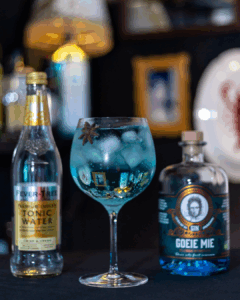
Ingredients
- 50 ml Goeie Mie Gin
- 150 ml Fever-Tree Indian Tonic
- Large clear ice
- Garnish: one star anise and four (frozen) blackberries
Instructions
- Fill your glass with ice cubes.
- Add Goeie Mie Gin.
- Add the tonic water.
- Stir gently.
- Garnish with star anise and blackberries.
- Enjoy!
Remember: Drink Responsibly, Don’t Spill Any!😉
📸 Capture the dangerously delightful magic of your Goeie Mie Gin & Tonic and share it with #WorthingtonsBar. Watch the floral botanicals bloom, the elderberries glow, and toast to a gin that’s inspired by Leiden’s most notorious poisoner… safely, of course! Cheers to a story in every sip. 🌸💀✨
Final Thoughts: Why Leiden Should Be Proud
Goeie Mie Gin ties together Leiden’s darkest folklore, Sylvius’ scientific legacy, and modern craft distilling. It is a gin that makes locals smile and visitors curious. It’s a reason to wander the Rapenburg, stop at the Hortus Botanicus, and then order a glass at a Leiden terrace.
And next time you pass a paint shop (in Leiden), you may think twice about what used to be sold there.
Raise a glass to history. Just not to arsenic.
❓Goeie Mie Gin & Tonic FAQ
Q: What botanicals are in Goeie Mie Gin?
A: Juniper, elderflower, elderberry, citrus peel, cardamom, coriander, cinnamon.
Q: Why is Goeie Mie Gin sometimes blue?
A: Compounds from juniper bark that survive fermentation.
Q: Who created Goeie Mie Gin?
A: Josine Heijnen, Leiden historian, launched it after researching forgotten women of Dutch history.
Q: Where can I buy Goeie Mie Gin?
A: Online, select Dutch shops, or locally in Leiden.
Q: Was Goeie Mie really in the Guinness Book of Records?
A: Yes. Maria Swanenburg is listed as one of the world’s most prolific female poisoners.
Q: Is it safe to use elderberries?
A: Yes. Distillation neutralizes toxins. Don’t use raw berries at home.
Q: Did Josine present the Goeie Mie gin on Dragon’s Den?
A: Yes, and she secured investment, helping the brand grow.
If you want to see the video tutorial on this drink, check it out on our Instagram page and TikTok! We would love to connect with you and hear about what recipe we should make next. 😁
September Cocktail Roundup: The Piña Colada (Reimagined), Goei Mie Gin & Tonic, Mudslide, Paloma, White Chocolate Martini, Negroni Sbagliato & Dominicana - Worthington's Bar
September 30, 2025 @ 12:39
[…] Full Goeie Mie Gin & Tonic recipe here […]